

Debt and Judgment Enforcement
From reviewing the enforceable instrument or judgment to calculating the amount due and preparing judicial enforcement, with AI assistance.
Looplex’s Debt and Judgment Enforcement solution helps law firms and legal departments analyze obligations that may be enforced, calculate amounts due, and prepare the pleadings and documents needed to pursue collection through the courts.
The work may begin with an extrajudicial enforceable instrument, a judicial decision, or a settlement in default. Based on these materials, the solution organizes the terms of the obligation, identifies creditors and liable parties, supports the assessment of enforcement requirements, and connects legal analysis with the statement of calculations, supporting documents, and requested relief.
The procedures described here follow Brazilian civil and labor procedural law. Filing an action to enforce an extrajudicial instrument (execução de título extrajudicial) is a specialized application of Pursue a Claim. Preparation of the new action incorporates the checks specific to enforcement, drawing on the capabilities for gathering supporting materials, drafting the initial petition, preparing court fee payments, and submitting documents for filing. Enforcement of a judicial title, including judgment enforcement (cumprimento de sentença) and enforcement in labor proceedings, builds on the work in the originating case, with the appropriate case links and filing procedure.
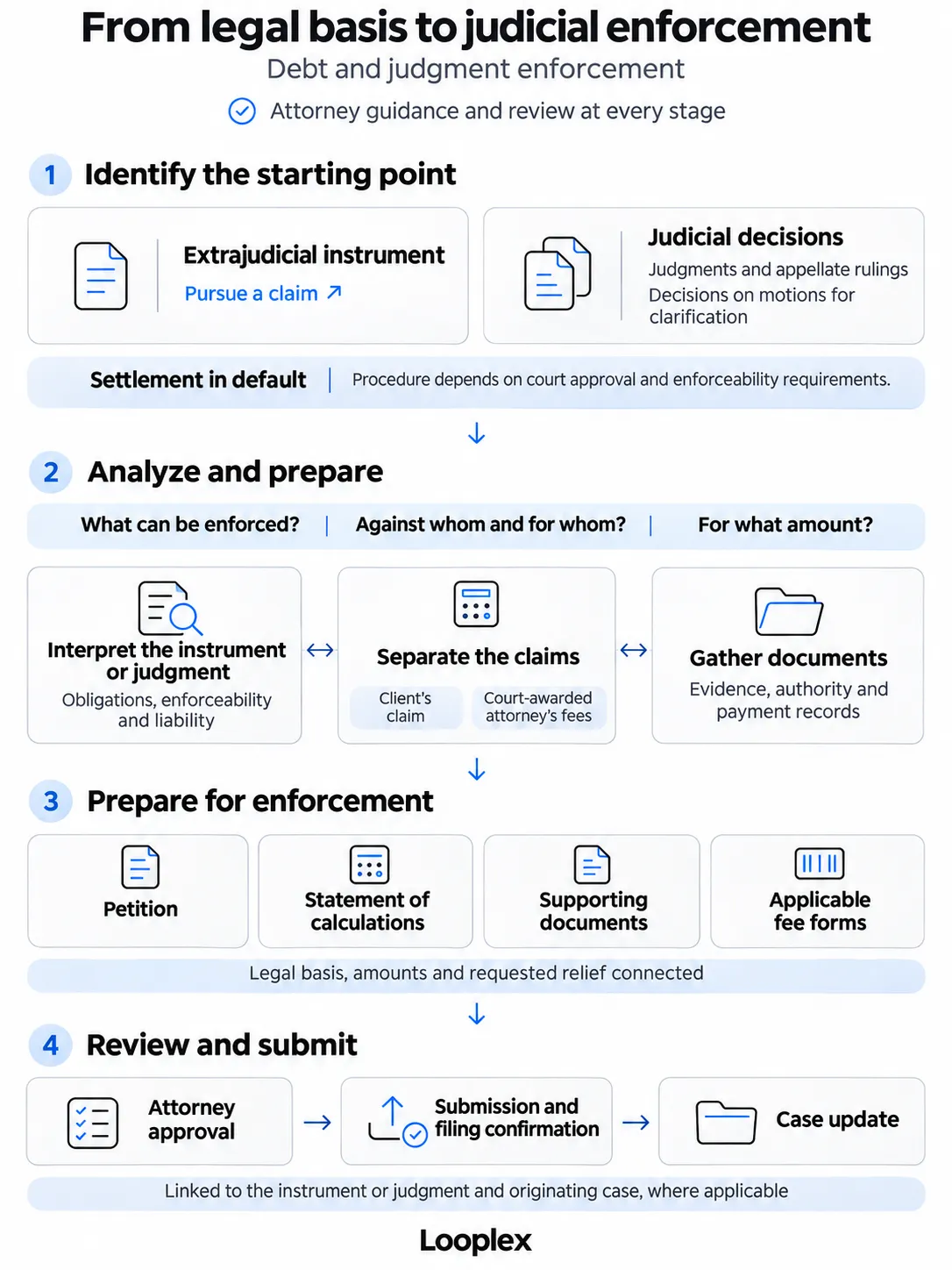
Understanding the instrument or judgment and the collection context
The attorney provides the instrument or judgment and related documents, or uses materials already associated with the case in integrated systems. The Assistant helps organize the history of the obligation, identify the default, and clarify the intended outcome.
For extrajudicial instruments, the analysis considers the main instrument, amendments, attachments, and documents that clarify amounts, due dates, and conditions for performance. For judicial enforcement titles, Decision Analysis supports a combined review of the judgment, appellate rulings, decisions on motions for clarification, and other relevant orders.
The work identifies what was upheld, modified, supplemented, or limited during the proceedings. If an appellate ruling changes part of the award or limits a debtor’s liability, that change informs the calculations and the preparation of the requested relief. Conclusions remain linked to the documents and passages that allow them to be checked.
Assessing enforcement requirements and choosing the procedural route
The Assistant supports the assessment of whether the obligation is certain, its amount is fixed or ascertainable, and it is due and enforceable, according to the nature of the instrument or judgment. The analysis may cover:
- Formal requirements of the instrument and documents that supplement it.
- Due dates, conditions, reciprocal obligations, and evidence of default.
- Payments, discharges, and other circumstances affecting the claim.
- Appeals, stay orders, limitation periods, and relevant preliminary steps.
The attorney uses this information to determine how to proceed, considering the appropriate procedural route, the competent court, the scope of collection, and any additional information needed.
For judgment enforcement, the work distinguishes amounts that can be determined through arithmetic calculations from situations requiring a prior proceeding to determine the amount due (liquidação). It also considers provisional or final enforcement, the portions of the judgment covered, and the effects of pending appeals under the Brazilian Code of Civil Procedure.
In labor courts, preparation follows the specific rules for determining the award amount and conducting enforcement. Outstanding issues or questions of interpretation are presented to the attorney to guide the next steps.
Identifying creditors and the limits of liability
The solution organizes who holds each claim, against whom the obligation may be enforced, and which limits must be considered. The analysis may involve multiple creditors or debtors, joint and several liability, secondary liability, rights to require prior recourse against the primary debtor (benefício de ordem), guarantees, and limits by component, period, or amount.
This information guides the identification of the parties to enforcement and the presentation of the amounts due. The Assistant can also flag situations in which including another liable party requires a specific procedural step.
When different debtors are liable for the same obligation, the work preserves the relationship between the claim and the parties liable for it. This makes it possible to present the scope of each party’s liability and reconcile payments and balances without counting the same claim more than once.
Handling defaults under agreements and settlements
For settlements, the analysis brings together the executed agreement, the court approval order where applicable, the performance schedule, and records of payments or other obligations performed.
The Assistant helps identify obligations in default and the consequences provided for in the agreement, such as penalties, interest, notice requirements, or acceleration. Seeking payment of installments that have not yet fallen due depends on the applicable clause and the requirements for invoking it.
The work also connects the settlement to the original obligation, examining the scope of any release, the obligations preserved, and the agreed effects of default. This helps the attorney assess whether collection should be based on the settlement balance, another expressly specified basis, or additional steps.
Court approval informs the choice of procedure. Court-approved settlements may provide a basis for enforcing a judicial title; in other cases, the attorney assesses the requirements for enforcing an extrajudicial instrument or pursuing another appropriate route.
Gathering supporting materials and preparing documents
Issues identified during the analysis guide Evidence Gathering and Analysis. The workflow organizes available documents, identifies gaps, and routes requests to the responsible people.
Depending on the case, preparation may involve:
- Payment records, notices, and documents demonstrating that an obligation is due or a condition has been fulfilled.
- Account statements, financial schedules, and information needed to calculate the outstanding balance.
- Powers of attorney, instruments delegating authority to other counsel, and representation documents.
- Corporate records establishing the authority of the person granting the power of attorney, including documents appointing that representative.
- An up-to-date property registry extract and documents supporting the collection of condominium assessments.
- Decisions, certificates, and procedural documents needed to support the application.
The solution can reuse existing documents and prepare drafts for signature, including through integration with Power of Attorney Management. When additional corporate acts are needed, their preparation follows the applicable corporate decisions and formalities. Official certificates and records are obtained from the competent sources or supplied by the responsible people.
The materials gathered remain linked to the obligation or requirement they help establish, making review and the organization of exhibits easier.
Calculating the amount due and preparing the statement of calculations
Calculations start from the criteria established by the instrument or judgment, applicable decisions, and the attorney’s legal instructions. The work organizes the amounts that may be claimed, their calculation bases and periods, monetary adjustment indices, interest, penalties, and applicable deductions.
The statement of calculations shows how the debt has changed over time and identifies the assumptions used, allowing each amount to be checked. The statements take into account the requirements of Articles 524 and 798 of the Brazilian Code of Civil Procedure, according to the procedure adopted.
Partial payments, court deposits, and security are identified according to their purpose and their effect on the outstanding balance. If an assumption is disputed, the attorney can request clarification or compare scenarios before approving the calculations.
In labor enforcement proceedings, calculations may include employment entitlements, their effects on related entitlements, social security contributions, and applicable withholdings, within the scope of the judgment and the procedure for determining amounts due under the Brazilian Consolidation of Labor Laws.
The workflow provides for integration with calcula.ai — Legal Calculations on Demand to prepare or verify calculations. The Assistant option requires attorney review; the partner calculation specialist option includes review and the responsible professional’s signature, according to the service contracted.
Calculator updates amounts already recorded in Cases between reference dates. Identifying the period covered by the statement of calculations prevents adjustment factors already included in the calculations from being applied again.
Separately identifying the client’s claim and court-awarded attorney’s fees
The work supports collection of the client’s claim, court-awarded attorney’s fees, or both, identifying the respective holders, calculation criteria, and amounts.
Court-awarded attorney’s fees (honorários sucumbenciais) are an independent entitlement of counsel and may be enforced within the same proceedings under the Brazilian Legal Profession Statute. Preparation considers whether to pursue the claims together or separately, according to the circumstances and the attorney’s instructions.
Even when collection is sought in the same filing, the Assistant identifies each claim separately in the statement of calculations, requested relief, and tracking records. It also distinguishes fees already included in the instrument or judgment from any fees that may become due as a result of the enforcement stage itself, subject to the applicable requirements.
Preparing the petition and organizing exhibits
Once the procedural route is defined, the Assistant helps draft the pleading based on the instrument or judgment, reviewed calculations, supporting materials, and the organization’s drafting standards.
For enforcement of an extrajudicial instrument, this step applies Pursue a Claim to the filing of an enforcement action. The initial petition brings together the grounds for using the enforcement procedure, the demonstration that the obligation is enforceable, and the corresponding requests for relief. For judgment enforcement or enforcement in labor proceedings, the filing takes into account the existing decisions and procedural posture.
Preparation may cover requests for service of process or notice, payment, enforcement measures, and urgent relief, according to the procedure and approved strategy. Exhibits are organized to make the instrument or judgment, statement of calculations, and supporting documents easy to locate.
Review checks that the instrument or judgment, calculated amounts, and requested relief are consistent. The attorney can adjust the scope of collection, supplement the supporting materials, and review the legal grounds before approving the final version.
Court fees and submission for electronic filing
Preparation uses the enabled Court Fee Calculation and Form Completion capabilities to identify applicable payments, prepare fee forms, and organize payment records.
These steps take into account the court, procedure, procedural act, and any applicable exemptions. Fee forms are routed to the person responsible for payment, and payment records are included in the documentation where required.
After legal review, the workflow checks the files, signatures, receiving court, and data required by the destination system. Depending on the Looplex Filing integration, it may track submission and incorporate the receipt returned by the court, distinguishing submission for filing from confirmation that filing has been completed.
Updating the case and tracking the work
Collection remains linked to the instrument or judgment and, where applicable, the originating proceedings. The workflow can support the creation of an enforcement case, the registration of an ancillary proceeding, or an update to the case phase, according to the procedure and the organization’s practices.
Records may include creditors and liable parties, separately identified amounts, versions of the statement of calculations, the reference date, documents, expenses, and the filing receipt. This information can feed Looplex Cases, Promad, and other integrated systems, including the client’s legal department environment.
Payments, settlements, and subsequent decisions may prompt a new analysis or updated calculations. The history preserves the assumptions used and makes it possible to identify changes between versions.
Looplex Assistant participates in the analysis and preparation of deliverables. In Autopilot mode, delegated activities follow the configured workflow and can be tracked in Workbench. There, the attorney clarifies issues, examines sources, and reviews deliverables according to the responsibilities and approval authority defined for the case.
Available operations depend on enabled capabilities, integrations, and the organization’s configuration.